
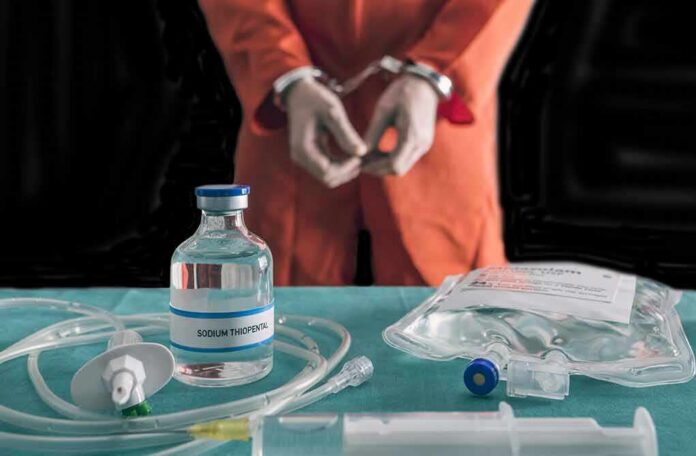
One company’s choice to stop making a single drug set off a 15-year scramble that has changed how America carries out the death penalty.
Quick Take
- Hospira, the only U.S. maker of sodium thiopental, stopped production, starting a nationwide shortage of execution drugs.
- States scrambled to find new suppliers, often turning to overseas sources, compounding pharmacies, and secrecy laws.
- European export bans and federal drug seizures cut off many of the replacement supplies states found.
- Some states switched to pentobarbital, firing squads, or nitrogen gas after lethal injection drugs ran dry.
- Botched executions have become more common as states use untested drug combinations under pressure.
How One Factory Closure Changed Executions Nationwide
For more than three decades, states used sodium thiopental as the first drug in a three-drug lethal injection mix. It put inmates under before the other drugs stopped their breathing and heart. Hospira, based in Illinois, was the only company in the country approved to make it. When the firm shut down production, the supply simply dried up.
Hospira first paused production in 2010 over manufacturing problems. In 2011, the company announced it would stop making the drug for good, citing concerns about its use in executions. With no backup domestic source and no plan to restart, 34 states that relied on lethal injection suddenly faced a hole in their execution process they had never planned for.
States Scrambled, Then Ran Into Federal Roadblocks
Corrections officials did not sit still. Florida lawmakers tracked how states rushed to find new supplies and switch drug formulas just to keep executions on schedule. Some states tried importing sodium thiopental from overseas manufacturers never approved by American regulators. The Food and Drug Administration (FDA) helped Arizona and California find a quick overseas source for the hard-to-find drug.
That workaround didn’t last. Federal authorities seized shipments of imported execution drugs headed for Arizona and Texas, saying the product was an unapproved drug that couldn’t legally enter the country. The Drug Enforcement Agency also seized Georgia’s entire supply over questions about how it had been imported. Each seizure forced states back to square one.
Europe Shut the Door, and Secrecy Became the Workaround
Much of the replacement supply states hoped to buy came from manufacturers in Europe. The European Union banned exports of products meant for executions, pointing to its long-standing opposition to capital punishment. That single policy choked off a major pipeline states had been counting on, pushing them toward compounding pharmacies and other less regulated sources to keep execution dates from slipping.
Finding suppliers willing to sell got harder as pharmaceutical companies publicly distanced themselves from the death penalty. One Texas official spent years quietly hunting for lethal drugs after the usual channels closed, a search that stretched on for years without a steady fix. States increasingly shielded supplier identities behind secrecy laws, making the drug pipeline harder for the public and courts to track.
The Fallout Shows Up in the Execution Chamber
The shortage didn’t just cause delays on paper. It changed what actually happens during executions. States swapped in pentobarbital as a go-to replacement once the original three-drug formula became unworkable. Alabama called off an execution in 2022 after staff couldn’t find a usable vein, an incident tied to the broader pressure states face finding reliable drugs and procedures.
Legal experts and reporters have linked the drug shortage directly to a rise in executions that go wrong, since states often use substitute drugs with little outside medical input. The federal government under President Trump’s Department of Justice took its own stance in 2019, arguing the FDA has no authority to regulate substances intended for executions at all, a move meant to clear legal hurdles states had been fighting for years.
Why This Keeps Happening
The shortage was never a onetime glitch. It’s the product of manufacturers walking away, importers getting blocked, and courts weighing in on every workaround states try next. As long as drugmakers refuse to sell for this purpose and federal agencies keep enforcing import rules, states will keep hunting for new fixes, and the public will keep hearing about executions that don’t go as planned.
States that still carry out the death penalty face a choice: keep adapting lethal injection with uncertain substitutes, or move toward other methods like nitrogen gas and firing squads already adopted in a handful of states. Either path traces back to the same starting point, a factory in Illinois that decided fifteen years ago to stop making a single drug.
Sources:
youtube.com, cnn.com, scholarship.richmond.edu, aclunorcal.org, journals.law.harvard.edu, pressbooks.lib.vt.edu, ilr.law.uiowa.edu, cbsnews.com, jurist.org, propublica.org, core.ac.uk, npr.org