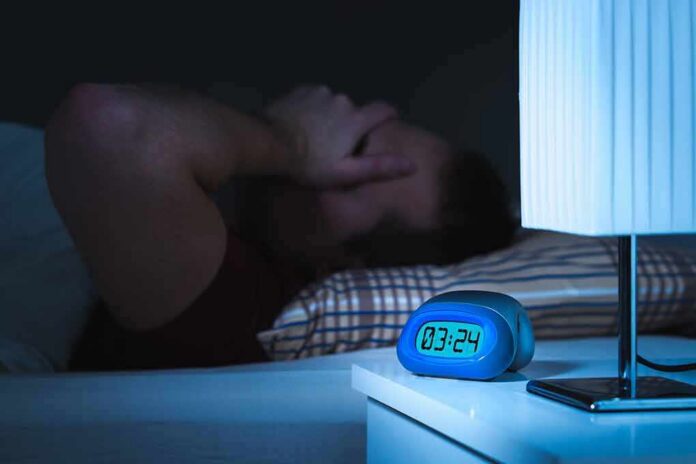
A new mouse study says your brain decides whether to wake you up at night based on what kind of memory it just replayed.
Quick Take
- Scientists found that replaying negative memories during sleep pushed mice toward waking up, while replaying positive memories helped keep sleep steady.
- The effect traces back to brain circuits linking the hippocampus and amygdala, the regions tied to memory and emotion.
- Researchers could control sleep disruption directly by switching these memory circuits on or off in the lab.
- The findings come from mice only, so human sleep habits have not been tested the same way yet.
What The Study Actually Found
Researchers set out to test a simple question: does the emotional tone of a replayed memory change how well an animal sleeps? The answer, published in the journal Science, was yes. Negative memory reactivation pushed mice toward waking up. Positive memory reactivation did the opposite, helping sleep stay smooth and uninterrupted.
The team didn’t stop at just watching this happen naturally. They identified the exact brain circuit involved: hippocampus-amygdala engram circuits, which are small, trackable clusters of neurons that store the emotional memory itself. When these negative-memory circuits fired during sleep, the mice were more likely to wake up.
What makes this more than a loose correlation is the control the researchers had over it. Scientists at Tsinghua University report that activating negative-memory engrams during non-rapid eye movement, or NREM, sleep reliably triggered wakefulness in the mice. Blocking those same circuits stopped stress-cue-triggered waking from happening at all.
Good Memories Acted Like A Sleep Shield
The flip side of the experiment tells its own story. When researchers activated engrams tied to a positive, rewarding social experience, mice slept more soundly. Their NREM sleep episodes ran longer, they woke up less often, and they stayed asleep even when researchers played disruptive background noise meant to jolt them awake.
That detail matters because it suggests positive memory replay isn’t just neutral background noise for the sleeping brain. It appears to actively protect sleep continuity under stress, acting almost like insulation against outside disturbances. Negative memory replay seemed to do the reverse, fragmenting sleep into shorter, choppier stretches with more transitions back toward wakefulness.
The Chronic Stress Connection
The researchers also tested what happens under chronic stress conditions, since poor sleep and stress often travel together in real life. In stressed mice, negative memory reactivation made sleep disturbances worse. When scientists specifically suppressed that memory reactivation, normal sleep patterns returned. That’s a meaningful detail for anyone who has noticed stress and sleeplessness feeding off each other.
This points to something conservative-minded readers will recognize instinctively: the brain doesn’t separate emotional baggage from physical rest. Carrying around unresolved stress or dwelling on bad experiences has a direct, measurable cost on the body’s ability to recover overnight. The data backs up what common sense has long suggested.
Why Mice Results Don’t Automatically Apply To You
None of this has been tested in humans yet. The experiments involved mice, specific lab-engineered memory circuits, and controlled stress scenarios. No human trial, sleep clinic study, or brain-scan replication has confirmed the same mechanism works identically in people. That’s a real limitation, not a minor footnote.
Still, the broader science of sleep and memory has been circling this territory for years. Other research has shown that sleep can selectively stabilize negative memories, and that cues disrupting sleep can interfere with memory processing in complicated, sometimes contradictory ways. The new mouse findings fit into that larger, still-unfolding picture rather than standing alone.
What Comes Next For Sleep Science
The obvious next step is a human version of this experiment. Scientists could use memory cueing techniques during sleep studies, paired with brain monitoring, to see if people show the same negative-versus-positive split in sleep stability. That kind of controlled, preregistered trial would turn an intriguing animal finding into something doctors could actually use.
Until that happens, the honest takeaway is narrower than the headlines suggest but still meaningful. A real brain circuit connects emotional memory to sleep quality, at least in mice, and chronic stress appears to hijack that circuit in ways that wreck a good night’s rest. That’s worth watching closely as the research moves forward.
For anyone lying awake replaying an argument from three years ago, there may finally be a biological explanation forming, even if the full human proof is still a few studies away.
Sources:
mindbodygreen.com, yahoo.com, pmc.ncbi.nlm.nih.gov