
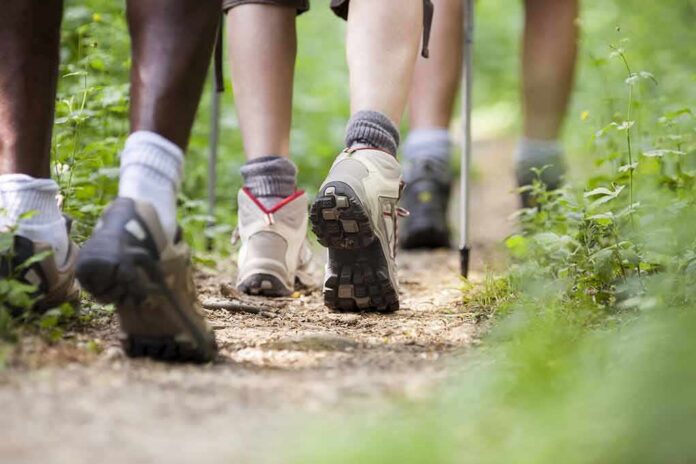
A UCLA memory researcher says a simple habit most people can do for free — walking a few times a week — may actually grow back brain tissue tied to memory loss in older age.
Story Snapshot
- UCLA psychologist Dr. Alan Castel told Dr. Andrew Huberman that regular walking improved memory in a randomized study of older adults.
- Participants walked about 40 minutes, three to four times a week, while a comparison group only stretched.
- The walking group’s hippocampus, the brain’s memory center, showed growth instead of its usual age-related shrinkage.
- Larger reviews of exercise research show mixed results on hippocampus size, even though exercise broadly helps thinking skills.
UCLA Psychologist Describes Memory Gains From Walking
Alan Castel, a psychology professor at the University of California, Los Angeles, discussed the link between walking and memory during an appearance on the Huberman Lab podcast with Dr. Andrew Huberman. Castel said research shows walking three to four times a week can boost function in the hippocampus, the brain region most tied to forming new memories.
Castel pointed to a study that randomly split older adults into two groups. One group walked for about 40 minutes per session, three to four times weekly. The other group only stretched for the same amount of time. After several months, the walking group scored better on memory tests than the stretching group did.
Brain Scans Show Growth, Not Just Slower Decline
The memory gains lined up with physical changes inside the brain. Castel said the walking intervention was tied to measurable increases in hippocampal volume, reversing the shrinkage that normally comes with age. One summary of the research put the growth at about 1% over a year, compared to the usual age-related decline seen in sedentary adults.
Follow-up testing extended well past the initial exercise period. Researchers checked participants again after six months and once more after a full year, according to a separate account of the same project. The walking group kept its memory advantage at both check-ins, suggesting the benefit did not fade quickly once people stopped the structured walking routine.
Larger Reviews Show a More Varied Picture
Bigger studies pooling data from many trials paint a less uniform picture than any single experiment. A meta-analysis of 38 randomized trials involving over 4,000 older adults found aerobic exercise, resistance training, and combined workout programs all improved general cognitive scores compared to inactive control groups. That supports the broad idea that movement helps the aging brain, even if the exact mechanism varies.
On the narrower question of hippocampal volume specifically, results are mixed. A meta-analysis pooling data from 554 older adults across eight studies found no statistically significant effect of aerobic exercise training on hippocampal volume, even though the same exercise programs improved participants’ cardiorespiratory fitness. Another pooled analysis of six studies reached a similar conclusion, finding no significant volume increase from aerobic exercise alone.
Other reviews found aerobic exercise helped some cognitive measures, like verbal fluency, while showing no measurable benefit for memory or executive function specifically. Researchers studying this area generally agree exercise dose, study length, and the specific population tested all shape the results, which is why findings vary from one trial to the next rather than pointing to one universal number everyone can expect.
Taken together, the research backs a simple, low-cost takeaway: regular walking appears tied to real memory benefits for older adults, and at least one well-documented study links it to hippocampal growth. Broader science suggests exercise helps the aging brain in multiple ways, even where the exact size of any single effect, like hippocampal volume, remains an active area of ongoing study.
Sources:
youtube.com, castel.psych.ucla.edu, crazystack.com.br, yolongevity.com, pmc.ncbi.nlm.nih.gov, pubmed.ncbi.nlm.nih.gov