
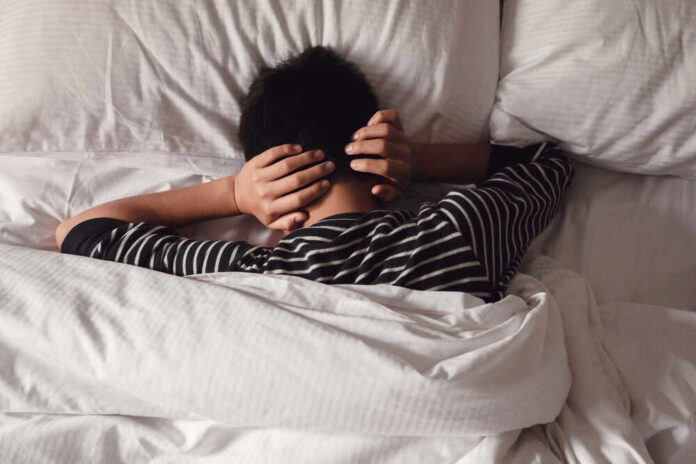
One missing sleep stage can leave the anxious brain stuck in yesterday’s stress.
Quick Take
- Researchers linked lower slow-wave sleep, the deepest part of non-REM sleep, with higher next-morning anxiety in older adults.[1]
- The study found that the pattern held even after adjusting for age, sex, total sleep time, and baseline anxiety traits.[1]
- Return visits about four years later showed less slow-wave activity and more anxiety, which points to a lasting pattern.[1]
- Other research still warns that anxiety and sleep loss often work in both directions, not just one.[2][3][4][5]
Why Deep Sleep Matters for Anxiety
Slow-wave sleep is the deepest form of non-REM sleep, and it appears to help the brain reset emotional stress overnight.[1][4] In the new older-adults study, people who produced fewer slow waves woke up more anxious the next morning.[1] That does not prove deep sleep is the only cause, but it does show that this stage may matter more than many people realize.
The research team also reported that the effect did not track with REM sleep in the same way.[1] That detail matters because REM sleep often gets more attention in popular talk about emotions. Here, the signal sat in slow-wave activity, the heavy, deep part of the night when the brain seems to do its best repair work.[1][3] When that repair looks weaker, the morning mood can follow it down.
What the Study Found in Older Adults
The strongest part of the report is its consistency over time.[1] A subset of participants returned roughly four years later, and the same pattern showed up again: less slow-wave activity and higher anxiety.[1] The researchers also controlled for age, sex, total sleep duration, and baseline anxiety traits, which makes the result harder to dismiss as a simple sleep-length issue.[1]
The study went one step further and looked at brain structure.[1] It found that shrinkage in emotional-control regions such as the amygdala, insula, and cingulate cortex lined up with fewer slow waves.[1] The authors argued that the brain changes did not directly cause anxiety. Instead, they seemed to weaken the brain’s ability to generate deep sleep, and that sleep loss then fed the anxiety.[1]
Why the Story Is Not One-Sided
The wider sleep-and-anxiety literature does not support a simple one-way story.[2][3][4][5][6] Earlier research says anxiety and worry are linked to disrupted sleep even when no formal anxiety disorder is present.[2] Reviews also describe sleep and anxiety as a two-way loop, where poor sleep worsens anxiety and anxiety then makes sleep worse.[3][4][5][6] That is why one study should be read as a clue, not a final verdict.
That two-way loop is the real problem for anyone searching for a quick fix.[3][4][5][6] If anxiety steals deep sleep, and weak deep sleep then leaves the brain less able to calm itself, the cycle can keep spinning. The practical takeaway is simple: sleep quality matters, not just sleep time.[1][5] For older adults especially, the deepest stage may be doing more emotional work than most people expect.[1]
What This Means for Readers
If anxiety has felt sharper lately, the issue may not be only how long you sleep. It may also be how much slow-wave sleep you are getting.[1] That stage is linked to recovery, emotional balance, and the brain’s overnight reset.[1][3] The new research suggests that when deep sleep fades, worry can greet you at sunrise with less resistance than before.[1]
That does not mean every anxious night comes from one missing sleep stage.[2][3][4][5][6] Stress, habits, age, and health all play a role. But the evidence now gives deep sleep a more serious seat at the table.[1][2][3][5] For a tired brain, the difference between ordinary sleep and slow-wave sleep may be the difference between carrying stress forward and letting it go.
Sources:
[1] Web – Feeling More Anxious Lately? This Sleep Stage Might Be Missing
[2] Web – Research Identifies Slow-Wave Sleep Activity as Regulator for …
[3] Web – Sleep Quality is Linked to Anxiety Disorders – Natural Health Research
[4] Web – Sleep and anxiety: From mechanisms to interventions – ScienceDirect
[5] Web – The Bidirectional Relationship Between Sleep and Anxiety
[6] Web – Anxiety and Sleep: Understanding the Connection for Better Rest